
Black Down and Hindhead Supporters helped fund the project leading to this magical moment on 1st June beside the River Wey in the middle of Farnham as the early evening traffic queued on the bridge above. Each box containing a single water vole was carefully lowered down to the water level allowing the animal to jump into the water and a life of freedom in the river.
Not only are these little creatures endearing, evoking memories of Ratty’s adventures in the Wind in the Willows, they are also keystone species in river ecosystems. Yet their numbers declined by 93% during the course of the 20th century, with habitat loss and predation driving them to the verge of extinction in Britain, and they have been absent from the River Wey for 20 years. It was clear that everyone present at the event was captivated by seeing water voles released into the River Wey, back to where they belong after so long!
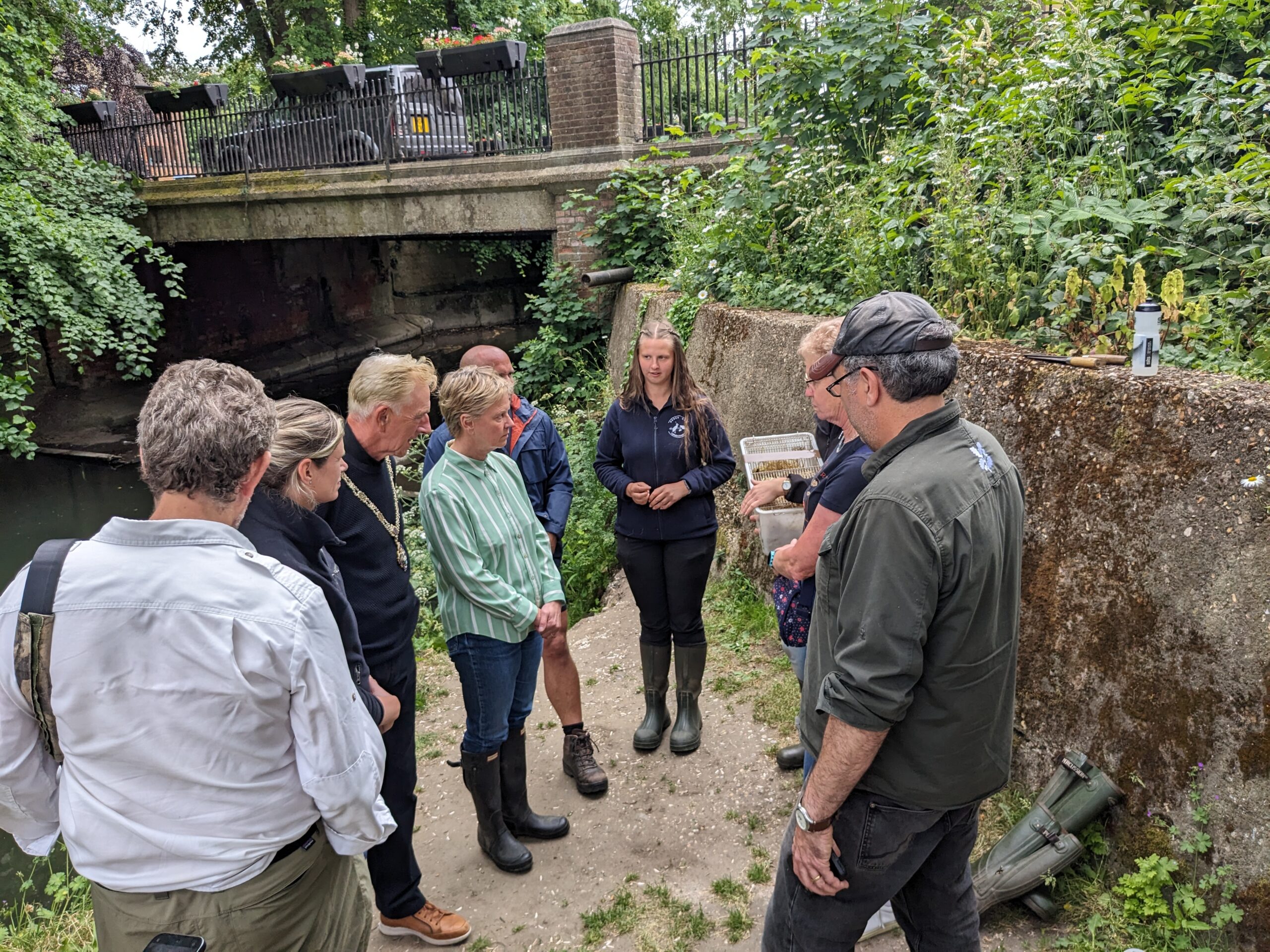
Led by the National Trust and Environment Agency, the project unites communities, landowners, and conservation groups. The Black Down and Hindhead Supporters were among those who provided vital funds for this special project which demonstrates the power of collective action to restore nature and biodiversity.
This event was part of the release of 300 water voles into the North Wey between Farnham and Froyle. This is the second in a series of planned releases across the 87 mile catchment, which aims to see the species make a recovery at a landscape level. Further waves of releases will happen over the next 12 months. Voles from the previous release have survived through the winter at all of the release sites, and the vision is to restore a sustainable population of water voles, all the way from the source of the River Wey on Black Down in the South Downs National Park, to Weybridge on the River Thames.
The project covers an area of over 1000 square kilometres, roughly equivalent to 2.5 times the size of the Isle of Wight. All thanks to a partnership of local people, landowners and organisations, led by the National Trust’s South Downs countryside team, the Environment Agency, the River Wey Trust, the South East Rivers Trust and Derek Gow Consultancy.
David Elliott, National Trust Lead Ranger for the South Downs West said: “Water voles have been locally extinct here for more than 20 years. But today we are bringing them back to the North Wey, right here in Farnham Town Centre. This wonderful little animal is making a come back and we couldn’t be more delighted than to share that with the people of Farnham.
We live in a time of wildlife and nature crisis, but we represent a group of people who are not prepared to accept that outcome. We are here to represent the work of hundreds of people across this river catchment who have come together to do something positive about bringing nature and wildlife back to this beautiful river. The water vole is a species that used to be common. The disappearance of the rare is what often grabs people’s attention, but the disappearance of the common is what we should all care about.
“What’s unique about the project is the collaborative effort of so many people, coming together to enable the return of a species. From people with a tiny stretch of the river at the bottom of their garden, to major landowners and conservation organisations, all taking positive action. This project demonstrates how citizens, organisations and communities working together can make change happen across a whole landscape. We can so do much more for nature as a collective, than we can on our own.”
The work has been funded by the National Trust, the Environment Agency’s Water Environment Improvement Fund and the Black Down and Hindhead Supporters of the National Trust.
The first stage of the project saw water vole releases in August 2025, in the upper reaches of the River Wey between Haslemere and Headley. Surveys this spring confirmed that these initial populations have established successfully. Alongside evidence of their bank-side burrows and feeding signs, the return of the species has been confirmed by eDNA water sample testing – and photos from remote movement-sensor cameras.
Water voles play an important role in the biodiversity of riverside ecosystems. They are a source of food for struggling predators like barn owls and otters. Where they graze on grasses and rushes, they help reshape habitats and create space for rare plants to grow. Yet during the course of the 20th century, the population of the water vole in England declined by 93% and has been in further rapid decline since 2000.
Water voles from part of many people’s childhood memories thanks to the character Ratty – not a rat, but a water vole – in The Wind in the Willows. Once regularly spotted at the river bank, they are now Britain’s fastest declining land mammal. The distinctive ‘plop’, as they enter the water, was a familiar sound for past generations. One of the key reasons for this decline is predation by North American mink, which escaped from fur farms in the 20th century. Population numbers of water voles, and numerous other species of wildlife such as kingfishers and sand martins, have declined dramatically.
Now multiple partners and landowners across the River Wey catchment, led by the National Trust and Environment Agency are standing together to reverse this decline. It follows 3 years of coordinated activity by river volunteers and monitors along the 87 mile waterway to prepare the way for them to thrive. Thanks to these collective efforts they are now ready for the return of the water vole to the River Wey.
Paul Davy, Environment Agency Catchment Coordinator for the River Wey, said: “We were keen to support this vital project and help re-establish the water vole, a much-loved native species and ecosystem engineer that has been absent from the Wey catchment for many years. This project has been a fantastic example of a catchment-based approach and effective partnership working. In addition to providing funding, the Environment Agency has helped the National Trust establish the network by drawing on our local knowledge and broad network of contacts within the catchment.”
Local volunteer and Farnham resident Libby Ralph, has played a key role in the project. She said: “I remember still seeing water voles in the 1980s, and as for everyone, they gradually disappeared without us realising. Then in 2014/15 I helped with a county-wide survey where we searched diligently, but very sadly concluded that water voles were functionally extinct in Surrey. I have hoped since that moment that one day we’d be able to return them to the River Wey. They are such iconic animals, and many people have a soft spot for them, often through the ‘Wind in the Willows’ connection. It has been inspiring to be part of this project and realising how many more people are enthused by it. All the landowners and organisations that have played a part are a wonderful community, and I hope this lays the foundation for many more actions for wildlife in our wonderful river corridor.”
Back to all posts